
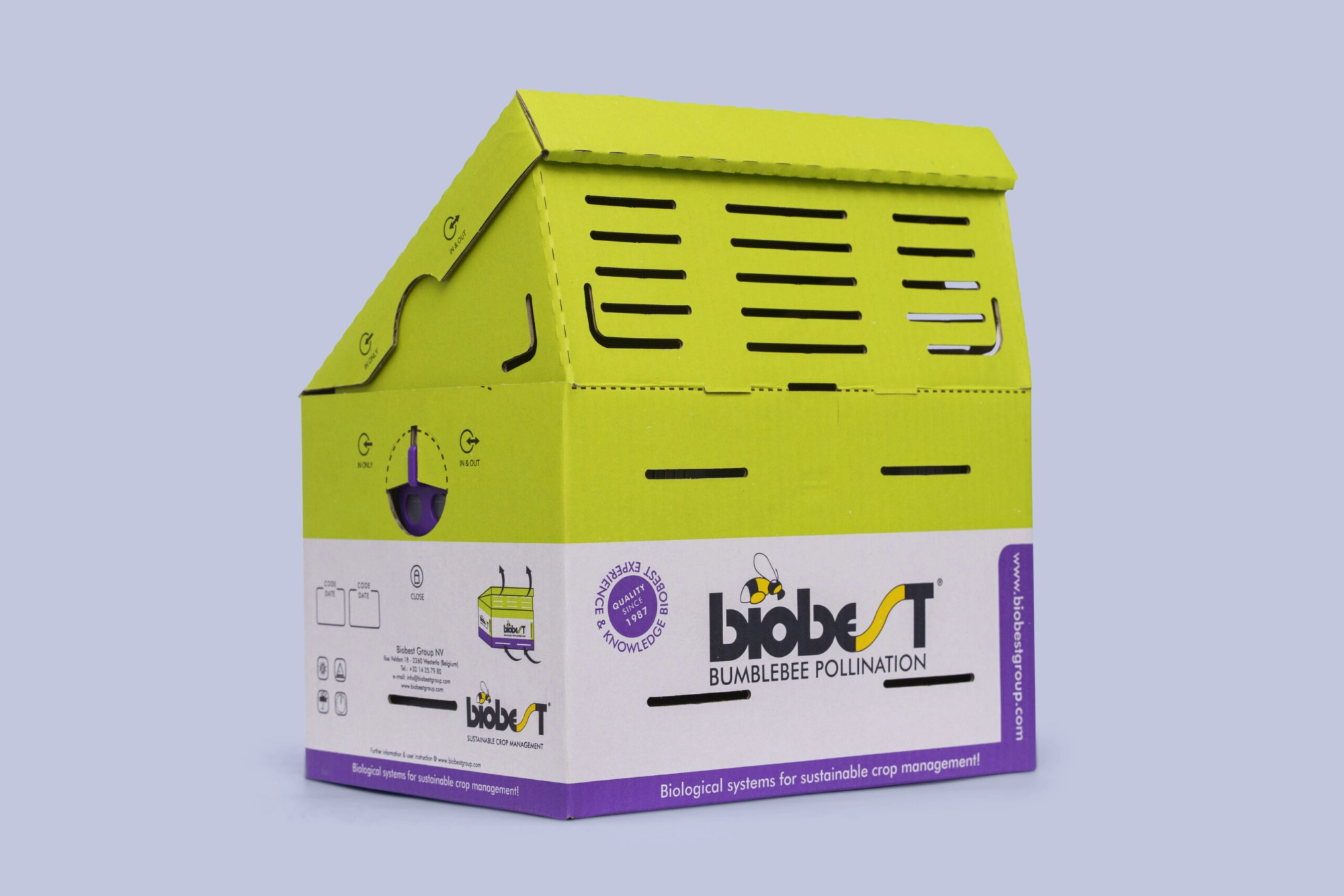
STANDARD HIVE
Product: pollination bumblebee
Packaging: 80 working bumblebees including a queen, workers, brood and sugar water
Working period: 6 – 8 weeks
Pollination area: 1000 – 1500 m2
Manufacturer: Biobest Group NV, Belgium
Bumblebees play an essential role in agriculture as pollinators of various crops. Bumblebee is especially developed to achieve the very best pollination results in crops with a flowering period of between one and four weeks. Bumblebees can be used in almost all open and closed field crops requiring pollination, such as: tomatoes, peppers, cherries, apricots, apples, pears, strawberries, water-melons, pumpkins, etc.
Bumblebees provide equal pollination, increase yields by 20-30%, as well as improve fruit quality. The number of hives required for high-quality pollination depends on the crop and conditions of use, therefore in each case it is selected individually. In orchards and berry fields, 6 – 12 hives are used per hectare per month.
Bumblebee hives must be placed evenly over the entire area, no more than 3 pieces in one place, while their entrances should look in different directions, but not directly at the crop. It is better to place the hives on an elevation, without tilting (horizontally), protecting them from direct sunlight and condensation (rain moisture). It is important to protect the hives from ants, which can be attracted by the syrup necessary for the nutrition and development of the bumblebee family. In the case of using hives in open ground, they must be fixed on a plane so that they do not overturn due to gusts of wind.
Bumblebee colonies can be released 4 - 7 days before the crop flowers. This does not have a negative effect on the colonies nor their pollination capacity.
- Position the hives evenly throughout the plot. The best position is on a horizontal platform just above the ground.
- Wait at least for half an hour after positioning the hives before opening the flight holes, this allows the bumblebee colonies to calm down.
- Protect the hives from direct sunlight and rain.
- Open the ventilation holes in the top of the hive during warm weather.
- Every hive contains food in order to keep the bumblebees in good condition during transport and storage.
- To guarantee the best pollination results, start using the hive on the day of arrival.
- Maintain the bumblebees at a temperature of between 15 - 25 °C.
- Avoid direct sunlight on the hive.